Delta Conveyance Project: Why It Matters to Yucca Valley and the Morongo Basin
We get our water from the State Water Project (SWP), a massive system that begins in Northern California, where most of the state’s snow and rainfall occurs. Through a vast network of dams, rivers, aqueducts, and pipelines, this water is delivered to Southern California communities—including the Morongo Basin and Yucca Valley—that rely on it for groundwater recharge.
Water resource management in California involves a careful balance of priorities between Northern California water rights, environmental stewardship and the water needs in Southern California.
At the heart of this delivery system lies the California Delta—a network of rivers, sloughs, and man-made levees that act as the gateway for water being pumped south. But this crucial infrastructure, much of it built in the 20th century, was designed with an assumption that snow would fall reliably in the mountains, store naturally, and melt gradually into our reservoirs each spring.
Over the years, we’ve seen how large storms are dropping more rain and runoff is unpredictable. Additionally, flooding, sea level rise and the threat of earthquakes concern scientists trying to model future outcomes of the water supply. Unpredictability has long been a factor in water management. It was catastrophic flooding in late 1955- early 1956 that led to initial emergency funding of the SWP. In 1960, voters approved the Burns-Porter Act to provide full funding for the SWP, which has played a vital dual role: controlling floods and managing water for dry periods. It’s a strategy that has served us well for decades, providing resilience through unpredictable climate cycles.
Upgrades Are Needed
More precipitation is now falling as rain rather than snow, and it’s arriving earlier in the year. Rivers are flowing heavier in winter, when our existing system isn't built to capture enough during the wet periods. As a result, California is losing vast quantities of water that we desperately need for the dry months ahead.
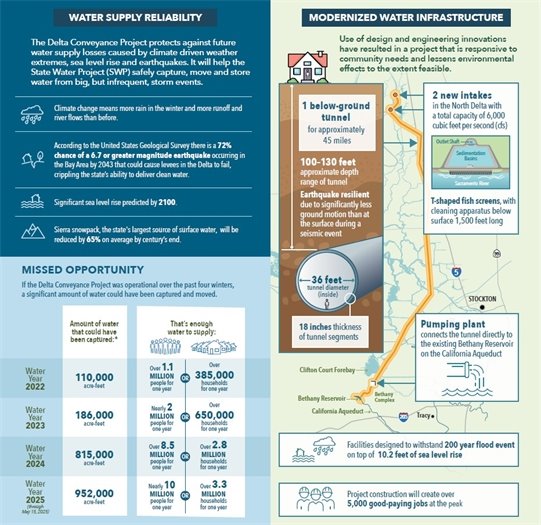
The Delta Conveyance Project (DCP)—a plan to modernize our water infrastructure and adapt it to heavy rainfall scenarios. The DCP would improve how water moves through the Delta, capturing it when it’s available, especially during storms, and conveying it to Southern California.
Planning Through Advanced Modeling
To ensure this investment meets future needs, water planners are using powerful climate models to simulate conditions as far ahead as 2070. These models evaluate seven different “no project” scenarios—including varying levels of sea level rise, land use changes, and climate impacts—to see how the SWP would fare without the DCP.
The results indicate that without the Delta Conveyance Project, annual average SWP water exports could drop by 430,000 to 680,000 acre-feet. That reduction would directly affect communities like Yucca Valley, which depend on those deliveries.
Why This Matters to Yucca Valley
For desert communities like ours, where every drop counts, the benefits of the Delta Conveyance Project are important:
Reliable Water Supply – Stabilizes long-term water imports, for groundwater replenishment.
Better Drought Resilience – Allows us to capture and store water during wet years for use in prolonged dry periods.
Looking Ahead
The Delta Conveyance Project is not just about pipelines and pumps—it’s about balancing a delicate environment, while securing a reliable water supply. The California Department of Water Resources leads this Program. This project promises to protect the water supply, while balancing the environmental concerns as identified during the Environmental Review.
As the DCP offers a solution, there are varying perspectives and environmental mitigation measures to be made to make sure a balance is maintained in nature, while meeting critical water needs.
Learn more about the project at https://www.deltaconveyanceproject.com/about-the-delta-conveyance-project

 Share on Facebook
 Share on Twitter
 Share via Email
